.png)

From identifying influential stakeholders to setting campaign goals, young women explored how strategic communication can turn climate knowledge into meaningful action.
On 9 October 2026, young women from GIZ and the Global Landscapes Forum (GLF) came together for the Changemakers for Agri-Food Action webinar, “Strategic Communication for Advocacy: Powerful Messages to Drive Climate Mitigation.” The session explored how advocates can move beyond raising awareness to designing communication campaigns that influence decisions, mobilise support, and advance climate action. Moderated by Trisha Mandal, Partnerships and Communications Manager at YPARD, the session combined insights from climate programming with practical exercises in advocacy communication, campaign planning, and storytelling.
.png)
Opening the discussion, Julia Bosshard, Junior Advisor to GIZ’s Global Programme on Ambitious Climate Contributions in Agrifood Systems (ClimA), introduced the project and explored its contribution to sustainable food systems through climate mitigation and adaptation.
Agrifood systems are both vulnerable to climate change and a significant source of greenhouse gas emissions. Addressing these challenges requires ambitious climate action that reduces emissions while supporting food security, protecting livelihoods, and conserving biodiversity.
Julia highlighted the importance of communicating these interconnected benefits when presenting climate initiatives. For advocates, introducing a project effectively means more than explaining its activities; it requires demonstrating why the project matters, the change it seeks to achieve, and how its interventions contribute to broader climate and sustainable development goals. Identifying clear, compelling key messages is therefore essential. By connecting technical evidence to tangible benefits, communicators can help audiences understand the relevance of climate action and the opportunities it creates for people and communities.
Through the ClimA project, YPARD is supporting the dissemination and visibility of innovative, inclusive, and gender-responsive climate mitigation approaches in agrifood systems through youth- and women-centered dialogue, peer-learning, and policy engagement formats. This webinar was YPARD’s first activity under this project.
.png)
How can advocates ensure their messages reach the right people and inspire action?
This question guided the second part of the webinar, led by Astrid Peraza, Community and Action Program Storytelling and Content Officer, and Daniela Regalado, Social Media Consultant, both from the Global Landscapes Forum (GLF). Their session focused on advocacy communication and the essential elements of an effective campaign: a clear goal, a strategy for achieving it, and a compelling narrative that connects with the intended audience. Rather than approaching communication as a series of standalone posts or activities, participants explored how campaigns can be structured around a specific change objective, with messages and tactics designed to support that goal.
The facilitators guided participants through practical exercises, beginning with power mapping to identify the stakeholders who influence an issue, hold decision-making authority, or could support a campaign. Drawing on the Power Mapping and Analysis guide, participants considered who needs to be engaged to advance their advocacy objectives. The discussion then moved to campaign goal-setting, using a campaign goals worksheet to explore how advocates can define the change they want to achieve and establish a clearer direction for their communication efforts. To bring these concepts together, participants analysed examples of successful campaigns and brainstormed ideas for future advocacy initiatives. This exercise encouraged them to consider how strategic messaging, audience engagement, storytelling, and coordinated communication can help transform an issue into a compelling call for action.
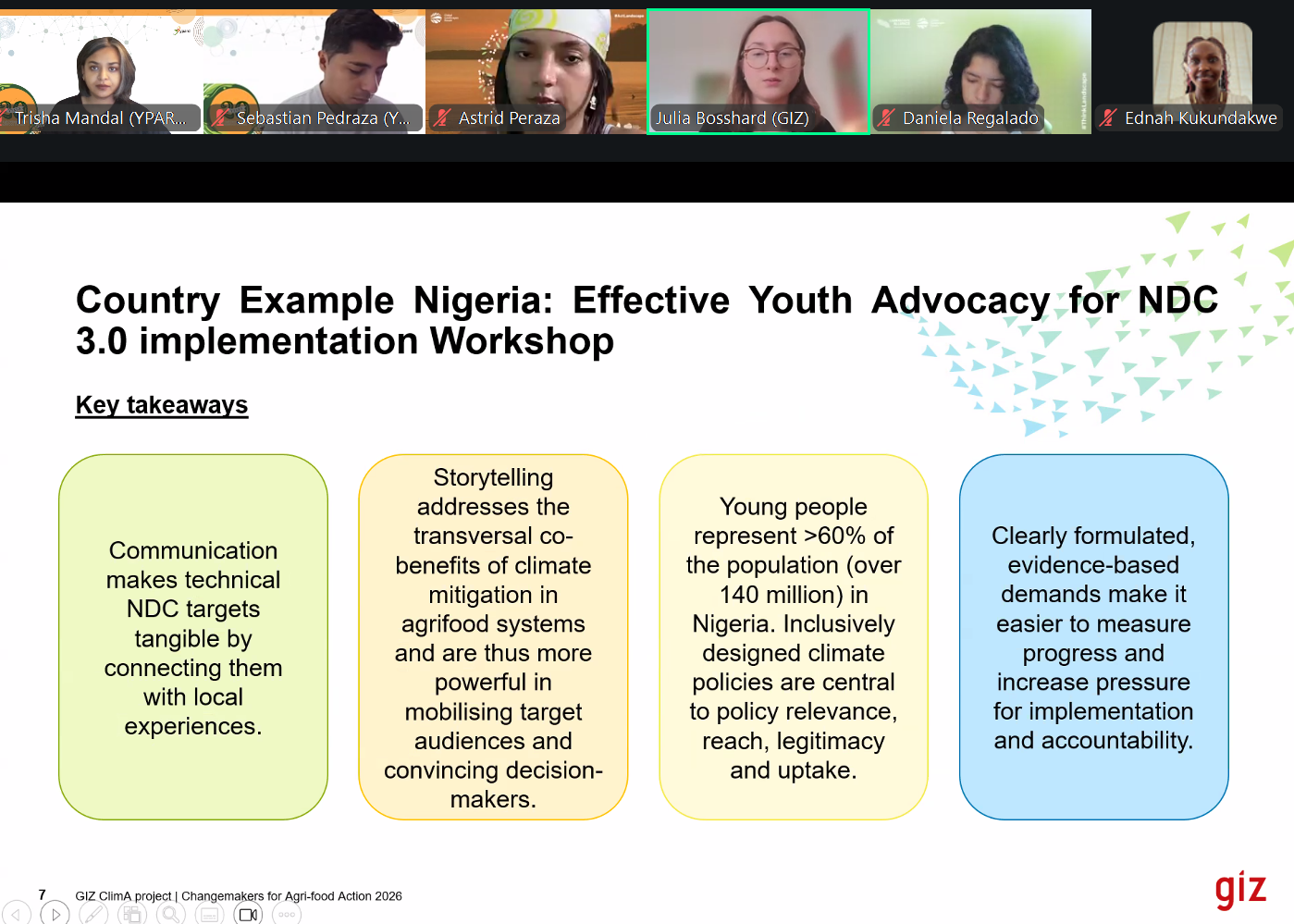
The session reinforced an important lesson: effective advocacy starts with clarity about the change you want to create, the people who can help make it happen, and the message that will move them to act.
For young women working across agriculture, food systems, and climate action, these skills are particularly valuable. They can help amplify community experiences, make technical evidence more accessible, strengthen engagement with decision-makers, and build support for solutions that benefit both people and the environment.
As climate challenges become increasingly urgent, strategic communication has an important role to play in connecting knowledge with policy, commitments with implementation, and local experiences with wider action. Through the Changemakers for Agri-Food Action series, young professionals continue to strengthen their capacity to contribute to climate advocacy and sustainable agrifood systems.
Because climate action is not only about having the evidence or the solution. It is also about communicating why it matters, building the support needed to act, and turning a shared vision into lasting change.
.png)