
The WYNA Community Solutions Fellowship, part of the Building Women & Youth-led Network Alliances for Agroecology and Organic Agriculture (WYNA) Programme, is designed to equip young leaders across Africa with practical skills, leadership capacity, and hands-on experience in advancing agroecology and organic agriculture. Through mentorship, structured training, and real-world project implementation, the fellowship empowers young women and men to address local agrifood system challenges using sustainable and community-driven solutions.

Central to the fellowship is a modular training approach, which combines virtual learning sessions, expert facilitation, peer exchange, mentorship, and the development of Community Solutions Projects. Fellows identify a specific challenge within their local agrifood system and design an agroecology or organic agriculture based solution to address it. Over the course of the program, Fellows engage in an eight-week blended learning curriculum that integrates global knowledge resources with practical application, ensuring that learning remains both technically robust and locally relevant.
A distinctive feature of the WYNA Fellowship is the strategic integration of learning resources from the Food and Agriculture Organization of the United Nations (FAO), particularly through the FAO elearning Academy. Embedding globally recognized learning materials into the WYNA curriculum ensures that Fellows are grounded in internationally endorsed frameworks while applying them within African agrifood contexts.
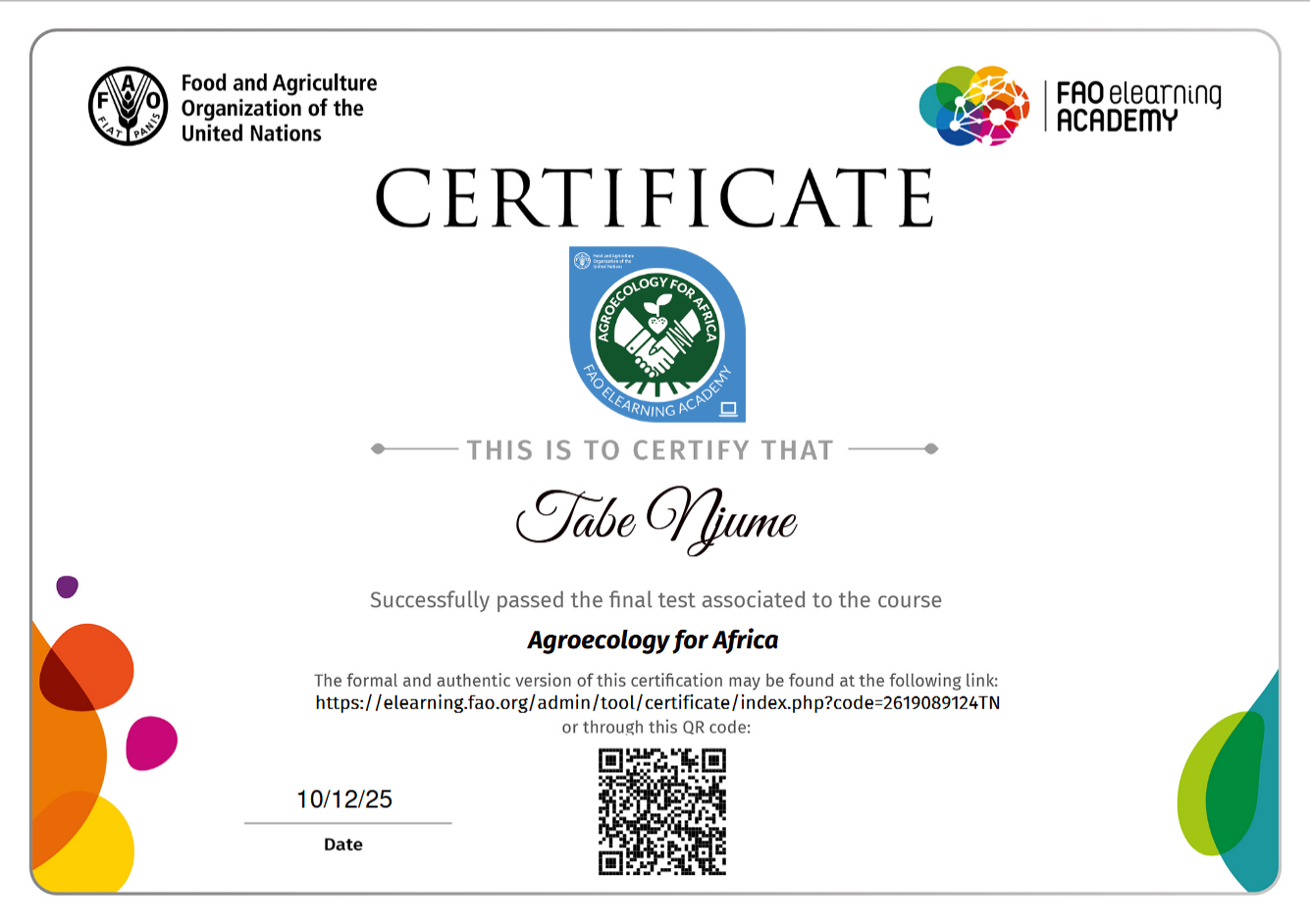
As part of Module 2: Introduction to Agroecology, all Fellows were formally enrolled in the FAO certified course “Agroecology for Africa.” Participants completed the full course, undertook the official assessment, and successfully earned FAO issued certificates.
This integration strengthened the academic rigor of the fellowship while ensuring standardized knowledge acquisition aligned with internationally recognized agroecological principles. Through the course, Fellows deepened their understanding of:
To ensure that learning moved beyond theory, Fellows engaged with the course content through guided discussions, reflective assignments, and integration of concepts into their Community Solutions Projects. Ideas such as multi-stakeholder engagement, policy support, and food system transformation were contextualized within local agricultural realities.
Following the completion of the FAO course, Fellows participated in facilitated reflection sessions and peer learning dialogues designed to deepen their understanding of agroecological systems and explore how the concepts could be applied within their communities. These sessions provided space for critical discussions around common misconceptions about agroecology, including debates on scalability, productivity, and policy relevance. Fellows also examined how agroecological transitions occur across different stages, from improving farming practices to redesigning entire food systems.
Most importantly, the knowledge gained through the FAO course continues to inform the design and implementation of Community Solutions Projects. Fellows are actively applying agroecological elements and principles in their initiatives, strengthening the coherence, sustainability, and potential scalability of their interventions.
The integration of FAO’s elearning resources has generated significant value for Fellows participating in the WYNA Fellowship.
First, FAO certification enhances professional credibility. Fellows now possess internationally recognized credentials that strengthen their engagement with farmers, extension officers, policymakers, and development partners working in agroecology and sustainable food systems.
Second, the course has reinforced systems thinking among participants. Fellows increasingly analyze challenges within the broader context of food systems, considering factors such as governance structures, biodiversity conservation, climate resilience, and market dynamics rather than focusing solely on production.
Third, FAO frameworks have contributed to higher-quality Community Solutions Projects. Fellows are now able to clearly articulate how their interventions align with global sustainability frameworks and agroecological principles, providing stronger evidence-based justification for their initiatives.
All Fellows successfully completed and passed the FAO certification assessment, demonstrating strong engagement and commitment to advancing agroecology.
Facilitators report improved conceptual clarity among participants and more confident articulation of agroecological principles during project presentations and stakeholder engagements. Fellows are increasingly referencing FAO frameworks when discussing their initiatives, strengthening the legitimacy and technical grounding of their work.
Community-based interventions implemented through the fellowship are also evolving toward deeper agroecological transitions, moving beyond simple input substitution toward systemic redesign. Many projects now emphasize diversified farming systems, strengthened producer–consumer relationships, and improved ecological resilience.
Importantly, certification has also strengthened Fellows’ professional identity, positioning them not only as youth participants in development programs but as emerging agroecology leaders equipped with globally validated knowledge and practical experience.
The Building Women & Youth-led Network Alliances for Agroecology and Organic Agriculture (WYNA) Programme, supported by Deutsche Gesellschaft für Internationale Zusammenarbeit (GIZ), was officially launched on 17 September 2025 and runs from July 2025 to December 2026.
The program aims to strengthen women- and youth-led networks across Africa to advance agroecology and organic agriculture through structured training, mentorship, fellowships, and strategic partnerships. WYNA builds on the foundation of the Knowledge Centre for Organic Agriculture and Agroecology (KCOA) and works closely with continental networks such as Young Professionals for Agricultural Development (YPARD), Participatory Ecological Land Use Management (PELUM) Kenya, and the African Green Store Network (AGSN).
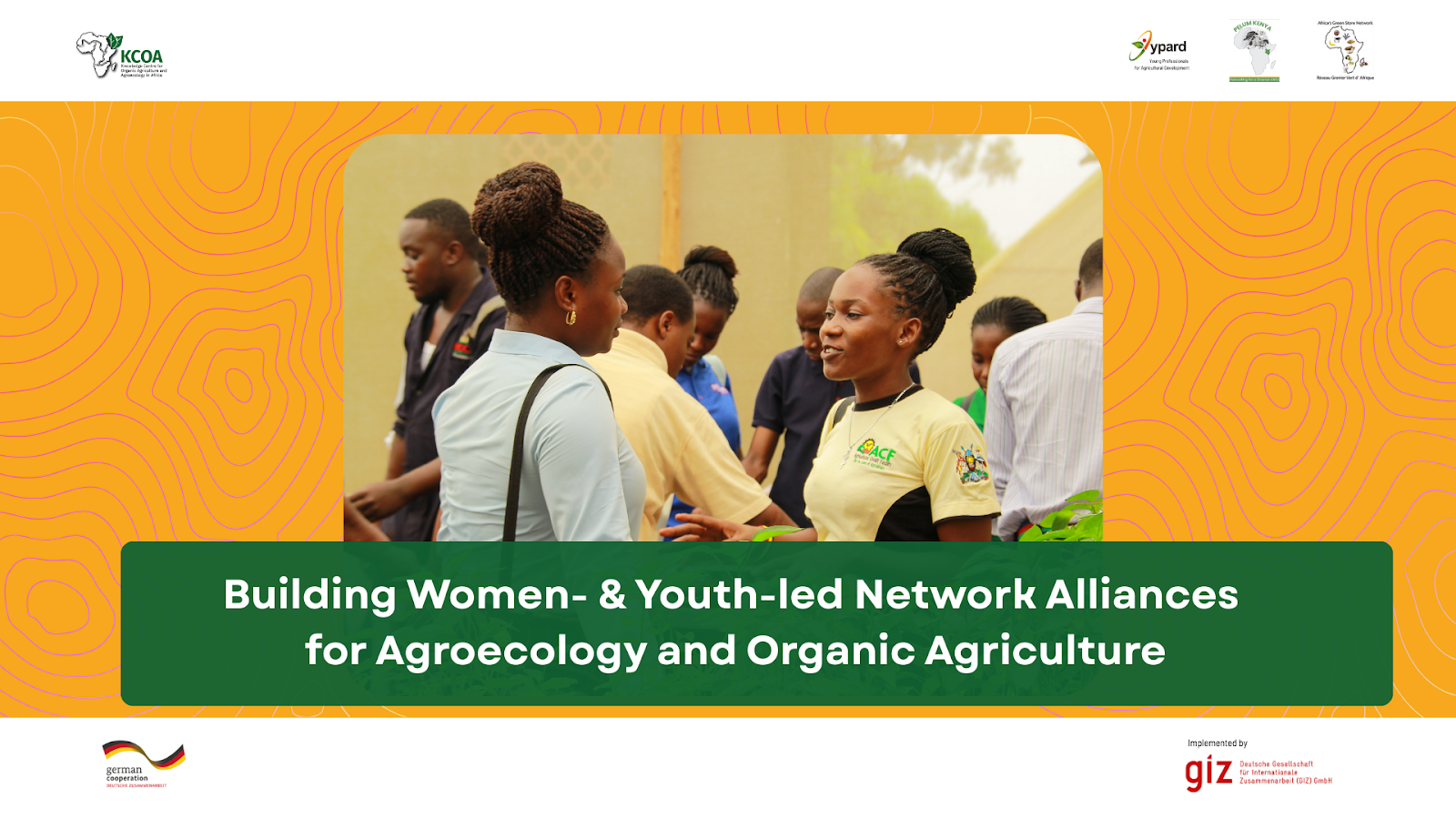
Rather than creating parallel structures, WYNA emphasizes intentional alliance-building, promoting collaboration among existing networks to strengthen synergies and maximize impact across KCOA partner countries.
The programme focuses on six core pillars:
Through initiatives such as the WYNA Community Solutions Fellowship, the program is nurturing a new generation of agroecology champions who are contributing to resilient food systems, sustainable livelihoods, and climate-responsive agriculture across Africa.
.png)