
In the coastal region of Satkhira, Bangladesh, climate change is not a distant concept. It is part of everyday life. Communities here live with frequent cyclones, tidal flooding, salinity intrusion, and environmental degradation. These challenges directly affect livelihoods, food security, biodiversity, ecosystems, and the future of young people. For many families, the environment is not an abstract issue. It is deeply connected to survival.
Located near the Sundarbans, the world’s largest mangrove forest, this region stands on the frontline of climate vulnerability. Yet, it is also a place of resilience, where young people are stepping forward with determination and hope.
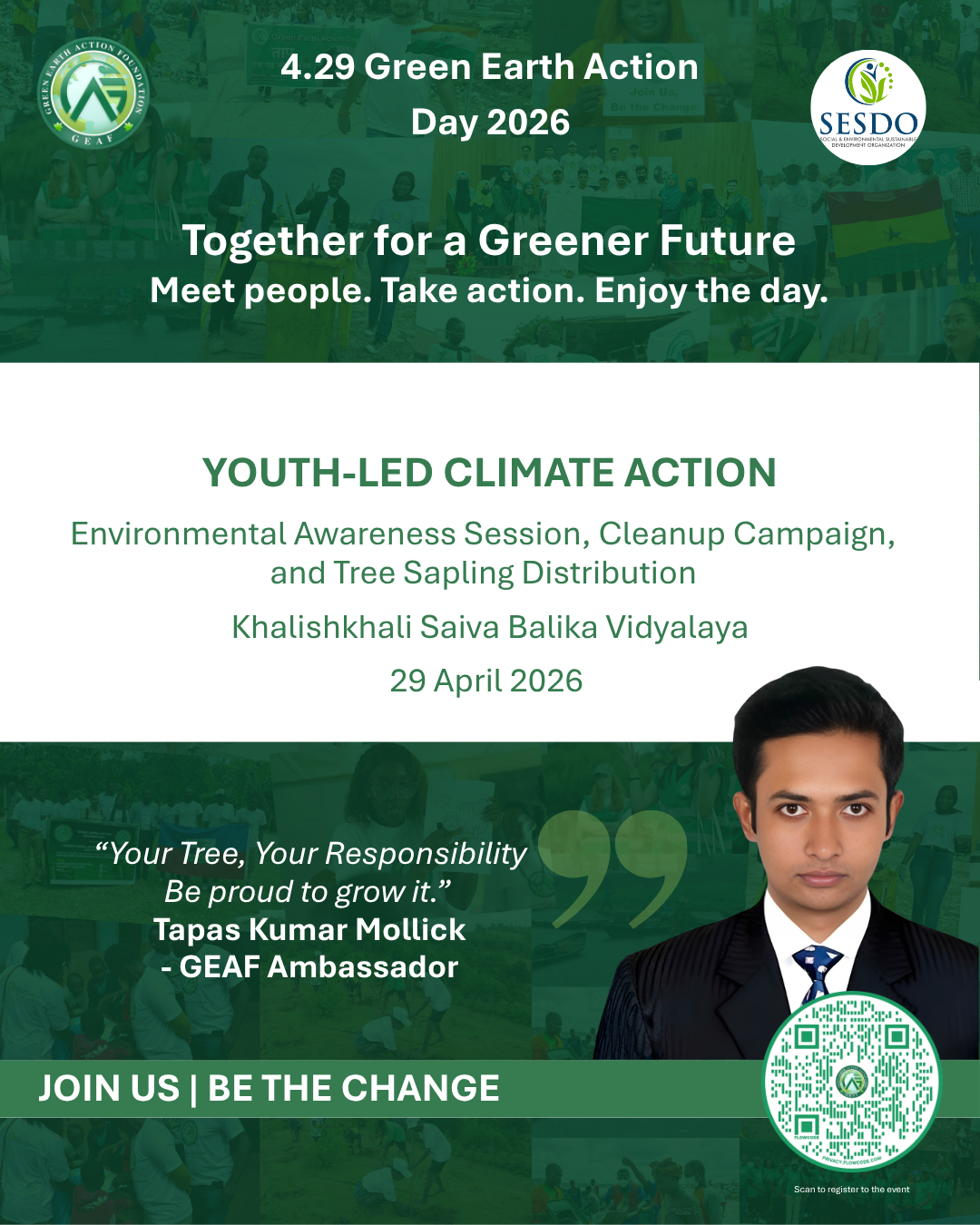
The event aims to engage around 300 participants, including students, teachers, and community members.
The programme combines learning with hands-on experience.
The event will begin with a climate awareness session where local experts, teachers, and community leaders will discuss climate change, biodiversity conservation, and plastic pollution. These discussions aim to help participants understand both the challenges they face and the solutions they can lead.
This will be followed by a community cleanup campaign. Students and volunteers will clean the school surroundings and nearby public spaces, promoting responsibility, teamwork, and environmental stewardship.
Under the leadership of Tapas Kumar Mallick, GEAF Ambassador 2026 and YPARD Bangladesh Partnership and Strategic Planning Lead, this initiative is part of the 4.29 Green Earth Action Day led by the Green Earth Action Foundation (GEAF). Implemented in partnership with SESDO, the programme empowers youth, women, and marginalized communities through environmental education, nature-based solutions, and community engagement.
A key feature of this initiative is the introduction of a tree ownership model, designed to ensure long-term sustainability.
“Each participant becomes a tree owner, turning a single sapling into long-term community impact.”
Tree saplings will be distributed to participants, and each individual will take responsibility for planting and nurturing their sapling at home or within their community. This approach creates a personal connection with environmental action and encourages long-term commitment. It is not just tree planting. It is about building ownership, accountability, and pride.
While the event will directly engage around 300 participants, its impact will extend much further. With approximately 250 students participating, this represents around 250 households. Considering an average of four family members per household, the initiative is expected to directly reach nearly 1,000 people.
This ripple effect highlights how youth-led initiatives can create meaningful community-level change, even through small, localized actions.
This initiative is more than a single-day event; it marks the beginning of a long-term journey. Participants will stay connected through a communication platform where they can share updates, photos, and progress related to their trees and environmental activities. Regular follow-up and simple recognition will help maintain motivation and engagement.
Through this continuous connection, the initiative aims to nurture long-term environmental stewardship among young people.
To join the movement, contact Tapas Kumar Mallick at sesdobd@gmail.com
Name
Organization
Designation